Ship’s Log 13

I’m back again for a final log before landing!

For today’s reading, I followed Lee Atchison’s “The Third Age of Webcomics” where Atchison discussed the following:

  • A brief history of webcomics that began in times even before the World Wide Web by the means of CompuServe
  • The three ages of webcomics (the last of which we are currently experiencing)
  • The dynamic between creators and readers

Atchison’s comments about creator-reader dynamic solidify several of the tenants that we discussed in class. The importance of having a regular update schedule, the ability to transition between web and print, and the sense of community a creator can make by interacting with fans are all characteristics for a thriving webcomic. The last characteristic is one that I’d like to focus on for today’s webcomic, Ava’s Demon.

Ava’s Demon promotional poster

In my opinion, the backstory for how the creator of Ava’s Demon, Michelle Czajkowski, got into the webcomics sphere is amazing. Czajkowski’s interaction with fans stems before her webcomic even came out. She began her online presence as fan art accounts on DeviantArt and Tumblr for Sailor Moon and other interests to garner an audience of over 10K followers before launching her webcomic. Fan art creators play a unique role of consuming original content but also producing, which gave Czajkowski the diving board she needed for her webcomic to be a success.

Czajkowski’s art of Usagi from Sailor Moon

Her followers from her fan art followed her when she posted her original series, and according to the Patreon article I read, she has over 100,000 dedicated readers for her webcomic.

It’s evident that staying in contact with her audience is important to Czajkowski because she has accounts on Tumblr, Twitter, Instagram, Twitch, and Patreon. Her Patreon account has tiered rewards, and support worth over $3 a month gives fans insight to her works in progress for the comic. If you go to her Twitter and Tumblr, she retweets and reblogs countless images of fan art to show to her audience what other people in the community are creating. Not only is this a form of acknowledgement on her part towards her fans, but it also gives her fans who may be aspiring artists more exposure that they need.
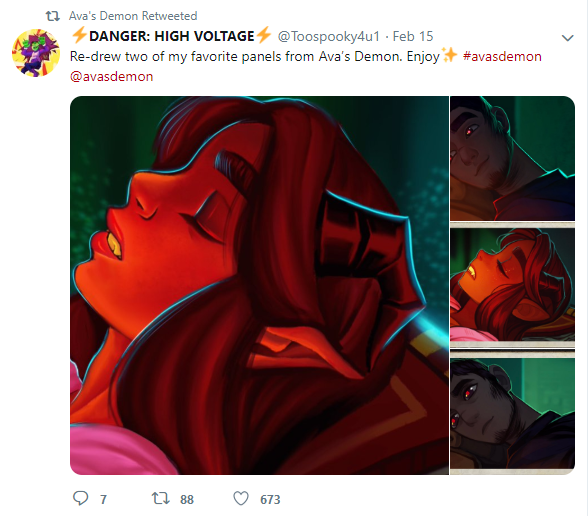
Fan art from @Toospooky4u1 featured on Ava’s Demon’s Twitter

Right now, Czajkowski lives frugally on her fan’s support and is working towards what she calls her “pipe dream” of opening a studio. She’s an example of Atchison’s analysis on how webcomic creators can create a fanbase and earn a living wage through their work while being bolstered by a community.

Thanks for reading!

Ship’s Log 12

In Osvaldo Oyola’s “The Pleasure of the Serial Comic Book,” Oyola longs for the seemingly indefinite comics that he could relentlessly pore over. If he were to ever miss an issue, the gaps in plot wouldn’t be detrimental to his enjoyment of the series. This concept contrasts with today’s comics that seem to have one arc per series, and series for specific characters are constantly being rebooted.

The concept of being able to enjoy the content of a series with the plot not in the forefront at all times fits well with my original webcomic, The Loneliest Astronauts. The story takes place in a chronological timeline with events that link back to previous panels. For example, there was a bit of plot where Dan and Steve came into contact with an alien, and a set of updates all related to one another. Yet, the updates could also stand alone.

Generally, readers can jump into The Loneliest Astronauts at any time because it’s not plot-heavy until the ending mini-series. In fact, nearly each panel is just another day of two guys messing around in space. And while reading, I had no idea when it would end.

Oyola mentions that when he was waiting between issues as a teenager, he would reread old issues and get the most he could from the page, even ads. Each time he read through, he would extract more and more information from the page. This ties back with another concept we discussed in class where webcomics go beyond just the strip and the entire website is worth looking into. I can verify that I’ve scrutinized the page of The Loneliest Astronauts looking for the alt-text, the interaction between creators and the audience in the comments, and links to other pages (like shout-outs to other creators, the store, or other Agreeable Comics).

Kevin Church also made references in the alt-text that were before my time, so I made sure to look those up too. Oyola actually says in his article that he finds paper comics superior to digital comics (especially because the reader can control the sense of time by choosing when to flip the pages), but I think digital comics can provoke the same sense of desperate analysis that he feels when waiting for an update. It’s just given in a different way that fits the affordances of webcomics better.

As always, stay tuned for next time!

Ship’s Log 11

For today’s blog, I continued exploring the webcomics universe by navigating through Hyperbole and a Half by Allie Brosh. And wow. The first two posts I read, “Menace” and “God of Cake” honestly strike fear in me. Children are terrifying.

To me, Brosh’s typical posts are indescribably funny because not only is she telling crazy stories from when she was a child, but also her stories have such a sophisticated phrasing while still being incredibly dramatic.

Of course, the main focus of today’s blog post is the comparison between the digital copy and print.

Just a cursory glance at the book shows that it’s color coded by the border color to distinguish the beginning and end of a mini-story. Some further digging is the difference between small details in the art, such as the eyes in the “A Simple Dog” comic. Brosh likely went back to retouch the art either in her blog or during production of the book, and if you think about it, this is a situation where the online medium of webcomics comes in handy because it’s easily customizable. On the other hand, a book is mostly set in stone once it rolls out onto shelves.

In addition to this concept, another that I think is key to story-telling is the idea of suspense that is better achieved in the webcomic than the book. Scrolling allows for readers to have no clue what’s in store for them beyond the one or two panels that are on their screen. However, in the book, it’s a two page spread, so a reader may glance at the images on the pages before they begin reading, and it takes away the uncertainty and build up.

This ties back to “suspenseful scrolling” that Jasmine talked about in her webcomic presentation on The Cheese in the Trap. It limits the reader’s abilities and gives them a slightly different perspective on the story than if they had the option to look at everything beforehand.

The layout of the two-page spread of the book also doesn’t allow for many panels to stack upon each other. It’s three at max in the book, but if there are many panels where the image is the same in the each one aside from one detail change, the book has a harder time displaying all these differences because at least one of the panels may be cut out.

Putting the last panel on a page you have to flip to get to causes a break in the story.

Stay tuned for next time!

Ship’s Log 10

In Hatfield’s “Transforming Spaces,” she discusses how transgender identities have been left out of academic spaces, libraries, and archives. To combat this lack of representation and information, transgender people have taken to webcomics to interact with their community and tell transgender stories.

I snooped around for community-content in other webcomics again, and this time I settled on xkcd. Although this webcomic isn’t representing marginalized audiences, Randall Munroe does have a large community following. This webcomic is the pride of geeks everywhere, and their main nesting grounds lay in Twitter and Reddit territory.

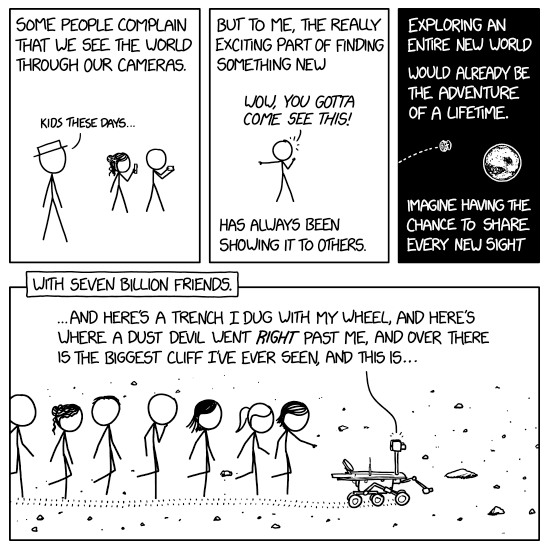
If fans are taken to something, spaces for fans to engage with one another grow organically on their own, especially with the versatility of the internet. This is shown by xkcd’s subreddit. Fans feel free to post, link to comics, and simultaneously react (the Opportunity rover currently has people feeling some feels).

“Opportunity Rover” (https://xkcd.com/2111/)

Unlike the examples in Hatfield’s excerpt where creators are actively engaging with viewers and asking “what’s next?” for their webcomic, according to a Reddit thread, the creator of xkcd Randall Munroe has disengaged himself from Reddit due to high volumes of unproductivity. Redditors implore him to answer their inquiries, but their pleas fall on deaf ears…

That being said, Munroe engages with his audience in other ways that still align with the ideas of xkcd. As David mentioned in his presentation, Munroe keeps a side blog titled What If? where he answers absurd physics questions that are submitted by the audience from his webcomic. Munroe’s direct interaction with his audience here falls more in line with Hatfield’s examples of participatory culture in “Transforming Spaces.”

“Earth-Moon Fire Pole” (https://what-if.xkcd.com/157/)

It turns out that the everyday geeky Jim isn’t the only person following along on Munroe’s science-y path. In an interview with The Atlantic, Munroe detailed that he started the blog for fun, but it ended up getting feedback beyond his expectations. For his first What If? post, MIT physicists contacted him about the hypothetical situation he addressed, told him they had simulated it in their machine, and gave him some corrections for his hypothesis.

Community doesn’t exist within just the webcomic content. People are drawn in from all over, and many fans interested in a creator’s work will follow them through various other projects that the creator picks up. Munroe’s community revels in the geek culture that he represents in his online platforms and his books, and every new addition to the collection is another morsel that people can relate to and admire.

As always, stay tuned for next time!

Ship’s Log 9

So the scholarly article I read was an excerpt from Janice Radway’s “Act of Reading the Romance” from Reading the Romance. This was published in 1991, so expectations of women were still pretty strict in the idea that women were caretakers of the house with responsibility over their husband’s and children’s emotional needs. The ladies Radway interviewed just wanted some time alone to read their books and to escape from their realities.

Because this blog post needed a deep dive into fan perspectives and The Loneliest Astronauts comes up a bit bare in that aspect, I decided to turn to Hark! A Vagrant, which might become my new obsession, and I thank Ben for originally talking about it with me.

Hark! A Vagrant logo

I couldn’t find the comments section of her works through her archives, so I turned to Tumblr, Instagram and Amazon reviews of her book to get the scoop.

An overwhelming amount of people just come for the laughs. Whether it’s from a bad day, an overwhelming workload, or something to start the day off right, so many people find Beaton’s interpretations of historical and literary figures really funny. We think of historical figures as stuffy or noble because we define them as “the greats” like Edgar Allen Poe, and many literary figures are tragic or heroic like the infamous Gatsby, but Beaton likes to spin their feats into humorous situations.

By framing history and literature this way, the audience doesn’t have to be very knowledgeable to get that it’s funny, and it just adds another layer of accessibility to viewers. Those who do know the context will find it even more humorous.

A lot of people talking about her work say it’s a history lesson you can laugh at. Her engaging works have inspired people to dig up information on the characters in the comic if they don’t get the references. Here’s an amazon review I found on the product of one of Kate Beaton’s books for Hark! A Vagrant:

Fathas: 5 Stars - An Excellent Comic plus History to boot

Hark! A Vagrant is by far one of my favorite webcomics series. It is engrossing and very entertaining, the characters always seem to reflect who you'd expect them to be except they don't take themselves too seriously. Another plus is you don't even need to know the historical figures, in fact I enjoy it more when I don't! Much like XKCD, a strip from Hark! A Vagrant frequently sends me to wikipedia to read the full bio of historical figures. I feel I've learned more about history from this webcomic than my 7+ years of history classes in school.

I sincerely hope many people buy Kate Beaton's book in support of her comic.

I think many people are drawn to this webcomic from the ones that got famous as Beaton’s works circulated through the Internet, and relatable panels became reaction images. A larger structure that determines how people find Beaton’s works is simply the diffusion of content across the internet, and the exposure leads to new readers. The Edgar Allen Poe one is everywhere.

As always, stay tuned for next time!

Ship’s Log 8

Subtitle: Last Day of Peer Presentations

So at the conclusion of the presentations, we can map several common tenants among webcomics:

  • Building audiences (and the off-shooting online stores)
  • Regular posting
  • The freedom a webcomic creator has
  • Representing marginalized audiences

It’s important to note that these aren’t common topics by coincidence. The first two in particular are essential to webcomics’ success because they capture an audience and (tend to) increase exposure in a positive feedback loop effect, and many creators make use of these practices. It’s important to incorporate these tenants as we educate people on webcomics because they’re so engrained into what today’s webcomics are.


Many of the webcomics that were presented are ones that are still on-going, and they have the luxury of employing tools such as social media to promote their works. In addition to that, the added exposure from cross-promotion among artists also boosts viewership. As I said before, the former point is something The Loneliest Astronauts couldn’t really afford because they were restricted to Facebook and Google+.

What I want to look into is Danielle’s unique situation where her webcomic is sponsored by Cosmopolitan. Just the sheer exposure her art gets is mindblowing (because who isn’t reading Cosmopolitan, right?). Now that I think about it, the platform that Cosmopolitan provides is not unlike how Jasmine’s webcomic uses Webtoon or John Z’s with GoComics. These companies have established orbital communities around themselves that new works can feed off of, whereas small independent groups such as Agreeable Comics have to work harder to fight for their part of the Internet attention. They’re limited to just their webpage and the Facebook page that was pre-the-intensive-user-data-mining and “advanced” algorithms of today.


Ananth from Johnny Wander did a sketch of Dan at
Free Comic Book Day at Comicopia (http://www.agreeablecomics.com/loneliestastronauts/?p=208)

Alas, The Loneliest Astronauts was made for fun for free, and it would be hard to find a sponsor for this kind of content. It does seem that TLA has the workings towards what makes webcomics successful (regular schedule, building audiences through communication and merchandise), but evidence suggests the timing was off.

I said the webcomic was not worth study, but John Y opposed me, saying it’s important to study what didn’t work to find the mistakes. Ajay agreed with me, but his overall opinion just seemed to sum up to “the webcomic interface sucked,” and that was that. Although webcomic creators have freedom with the infinite canvas and whatever content they want to include (no editors!), it’s limited by what the medium’s affordances are capable of, and their proficiency with the technology. Those in 2009 had more barriers in front of them than now.

As always, stay tuned for next time!

Ship’s Log 7

Subtitle: Day 2 of Peer Presentations

Good job to those who presented! As someone who went during this group, I can say I am very glad my time to shine was over with. But I did enjoy educating everyone on my webcomic!

Piyomaru jumping for joy
Piyomaru says congrats

I feel like a lot of people shied away from Day 1’s most popular theme, which was regular posting. Whether that was intentional or not, I really liked a point that Cat made when she referenced it. She made sure to emphasize that the reason we keep hopping on this theme is because it’s integral to a webcomic’s success. You need to post often and consistently to engage an audience. In her words, “you don’t want to be waiting a few weeks, or a month, or a year for an update.” So if anyone’s tired of hearing this theme yet, just know that there’s a very good reason that it keeps coming up.

Another worthy inclusion to our theme list is female creators and representation of marginalized groups. Cat, Nini, and Lorela all had great examples of successful women in the webcomic sphere. Not only that, but also Joey Sayers and Danielle Corsetto make references to the LGBTQIA+ community.

I think Joey Sayers’ story in particular is very powerful. She came out as transgender and lesbian through her comics because she felt that she would have more support from her fans than perhaps people in her immediate surroundings, and I like that Nini included that detail.

Finn and Jake from Adventure Time have their eyes shiny with awe.

I wasn’t sure if I understood this tenant from Ryan, but I sincerely doubt Dragon Ball Multiverse is the only series to originate from the web. Of course many things get initially drafted on paper, such as the original concept of Saturday Morning Breakfast Cereal, but most webcomics originate online to cater to an online audience. So in short, I think it’s a good tenant.

I’m not going to lie. I am slightly infuriated by Dinosaur Comic’s fame. At first, I didn’t think it was worth including in the exhibition, but Dr. Misemer said it would be interesting to study how Ryan North cultivated a following with the same images over and over. I grudgingly agree.

I wasn’t too surprised to see John’s contrasting opinion from mine about The Loneliest Astronauts because I also wanted to include it in the exhibition at first. However, his point is strong when he says that we should study the failed examples and figure out what separates them from the success stories. It’s a logical approach to research and definitely something to consider.

That’s all folks! Stay tuned for next time!

Ship’s Log 6

Subtitle: Day 1 of Peer Presentations

Thank you to all the lovely presentations from today’s speakers! We got a glimpse of many people’s thoughts on their webcomics.

Snape approves gif

One popular theme we saw the presenters discuss was the idea of building an audience whether through regular posting, the feeling of inclusion (merch, Easter eggs, etc.), or humor. While some of these ideas are listed as separate tenants, the concepts mostly go hand-in-hand.

I’m starting to think about the content of the online exhibition. While every webcomic has been great to see, something tells me not everyone can get the greenlight to be included. Perhaps it’s because we saw two xkcd presentations today, but I do believe xkcd would definitely be a worthy inclusion to the exhibition because it’s a wildly popular in the geek/nerd-sphere (in my experience too) and is a staple in the world of webcomics. Also, xkcd has great examples of utilizing digital affordances while also being able to translate easily to print. David’s example of “Right-Click” and McKay’s “Time” example are both of note. Also McKay with that Google search demographics?? Nice.

okapi from "Right Click." iykyk
okapi

Speaking of staples, Yang’s presentation over Saturday Morning Breakfast Cereal had a point that I think really harmonized with David’s backstory to xkcd and Yara’s backstory to Mom’s Cancer. The creators Zach Weinersmith, Randall Munroe and Brian Fies, respectively, are great examples of people who entered the webcomics field due to low costs. In addition, these people came from diverse backgrounds and each had their own unique stories to tell that were all wildly popular with their audiences.

I particularly liked Taylor’s tenant of “exploratory forms of representation”—specifically the bit about using scrolling to the story’s advantage. I thought of it more as forcing the readers to “slow down” (by spending more time on the specific panel) and take their time to appreciate what’s on the screen, and I see it applicable to other scenarios and webcomics too.

Do you love the color of the sky?

I'm sorry it's another Tumblr reference
I’m sorry it’s another tumblr reference

In a way, I feel like The Loneliest Astronauts is a bit distant from the examples of still on-going or more recent webcomics. Teddy, Hanes, and Yang all touched on the idea of using social media to launch webcomics into greater popularity, but the social media boom we think of today was after The Loneliest Astronauts’ time. If these original tenants are actually applicable to a wide-range of webcomics, then TLA is out of the loop.

Stay tuned for next time!

Ship’s Log 5

I read the excerpt from Richard Lanham’s Economics of Attention, and it primarily discusses the idea of the “attention economy.” Our society is so bombarded with (mostly) digital information that we are overwhelmed. It becomes adequate to call human attention a scarce resource like an economics concept. There are many topics Lanham touches on, such as filtering the information and the lack of “personal” property on the Internet; after all, this is merely chapter one of his book. However, in the words of John Mulaney, “we don’t have time to unpack all of that.”

Steve goes off about a heavy, soul-baring, profound reading by Robert Burns he was thinking about, and Dan replies "Oh. I was just contemplating Hello Kitty. SANRIO says she weighs the same as three apples. THREE. But they never tell you WHAT KIND."
“The Lower Depths” (http://www.agreeablecomics.com/loneliestastronauts/?p=74)

One point that Lanham made that struck me in particular was despite how scarce attention is compared to the massive waves of digital information, we still have people who rise up as celebrities. Focusing on these individuals turns attention economics into a distribution problem because if all the attention is here, where’s all the attention for the people who have maybe the same talent but less exposure? Or even a fraction of the talent but still beyond average?

Cue my shameless plug for my webcomic, The Loneliest Astronauts. It’s so amazing! The art style is incredible and the characters are engaging. I may have mentioned this before, but it seems like this webcomic never got popular. To be truthful, I can barely find anything on it when I do a Google search. So why is it that someone with rad art credentials like Ming Doyle has such an obscure work?

Steve wakes up Dan by smashing a rock into his helmet and Dan wakes up to Steve communicating with an alien. His response in the middle of his sentence is "Well it does seem realllWWWWHAAAAATTTTTHEFFFFFFFFF"

Steve says to the alien, "He gets like this." The alien replies in unintelligible symbols and Steve says "Oh yeah TOTALLY."
“Unreadable Communication” (http://www.agreeablecomics.com/loneliestastronauts/?p=211)

Of course, Lanham doesn’t give me any direct answers or clues, and I’ve yet to hunt down Kevin Church and Ming Doyle to demand some answers, so I couldn’t tell you exactly. Perhaps it was a bit early for its time when webcomics still held that stigma of being a nerd thing on the Internet (pointed out in “Webcomics: The Influence and Continuation of the Comix Revolution” by Sean Fenty, Trena Houp and Laurie Taylor). Maybe it’s because these days, people are looking for something relatable and quick to pop up on their Instagram feed, which ties back to the idea of society’s attention scarcity.

In a society where there is so much competition online, it’s very difficult to make your section of the Internet stand out. Perhaps The Loneliest Astronauts was just in the wrong place at the wrong time. However, I don’t think I’m alone when I say I’m glad to have found it.

As always, stay tuned for next time!

Ship’s Log 4

“Webcomics: The Influence and Continuation of the Comix Revolution” is an article by Sean Fenty, Trena Houp and Laurie Taylor that discusses parallels between the Underground Comix of the 60s to today’s surge in webcomics. The authors modestly argue that webcomics allow for expanded creativity with their works and discuss its benefits. Through themes of ethics as well as the sense of community that both platforms built, there’s been a continuous revolution by the comics medium.

Of course, I need to put this in terms of the webcomic I’ve been following—The Loneliest Astronauts. The authors say that although webcomics can be like Underground Comix where they can explicitly talk about sex and drugs and such, many are pretty tame. However, they’re so quirky that a publisher would pass up on them. I think this is where my webcomic falls in. I mean, look at them.

While singing "Bring the Ruckus" by Wu Tang Clan, Dan catches himself before saying some disagreeable language.
“Bring the Ruckus” (http://www.agreeablecomics.com/loneliestastronauts/?p=272)

To be honest, it falls a bit flat when it comes to the revolutionary aspects of the cited comics in the article. From what I’ve seen so far, the webcomic hasn’t tackled any ethical issue that the medium allows for. The comic just seems to have been created for fun and is fun in nature. Ming Doyle, the artist, even pokes fun at her own work.

She says to another artist: Also T.J. your comic is an intricate story with an intense plot filled with crucial details and nuances. I draw two dudes hurling pudding cups at each other in space. Your role requires greater integrity! And I am always blown away by and impressed with your work. And so is everyone else, I think. Especially Kevin. :)

Webcomics supposedly appeal to a niche group of people such as the gamer culture but are successful because of the wide distribution the internet provides. Because of their platform, they tackle issues such as hacking, where hackers are villainized by society but in reality the effects and applications are massively exaggerated. However, Dan and Steve have no profound commentary on society. Maybe the comic is a mockery of people who can’t perform conflict resolution.

Steven: even if you've managed to screw up our first contact with extraterrestrial life, I can't deny that this was a wholly remarkable moment in human history and I'm amazed and stunned that I was part of it.
Dan: I wonder what their next step will be.
Steve: Who knows? I'm just glad I got to experience this with you.
Dan: WOW, Steve. Thank you. That means the world to me. I feel like we've begun a new chapter in our lives.
*Ten minutes later...*
Steve: Why is it always your fault?
Dan: I dunno, why do you SUCK so much?
Steve: Why do YOU suck so much? That's MY question.
“Show Me The Way To Go Home” (http://www.agreeablecomics.com/loneliestastronauts/?p=266)

Despite the inconsistencies with the main arguments in the article, I do find that The Loneliest Astronauts does follow the authors’ points about creating a webcomic network and community. Kevin Church, the co-creator, constantly references other content creators, and posting guest comics encourages people to check them out and support their works. Church and Doyle often engage in the comments section, and overall, there is a sense of connectivity that correlates with Fenty, Houp and Taylor’s observations on the Underground Comix and webcomics revolution.

As always, stay tuned for next time!